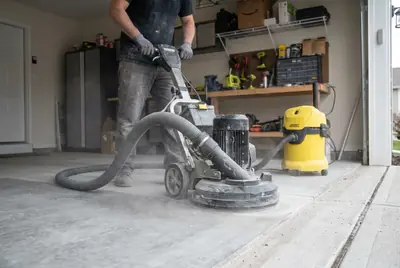
Diamond grinding
Machines with vacuum shrouds open the slab pore by pore. The dust stays in the extractor, not on your shelves or the car in the driveway.

The crew we send in Smithfield grinds the slab, mends the cracks and pours the finish, house by house across Providence County. Garages and basements only, done properly.
Free, in writing, after a walk across your actual slab.
Here is the sentence we repeat at every kitchen table: about eighty percent of how your floor looks in five years is decided before the first drop of resin leaves the bucket. Epoxy does not fail in the middle of the room. It fails at the bond, and the bond is made or lost during prep.
A cured slab is smooth, sealed by its own laitance and often by old paint or curing compounds. Resin cannot grip that. We run diamond grinders with dust extraction across every square foot until the surface feels like fine sandpaper, because that texture is what the epoxy keys into.
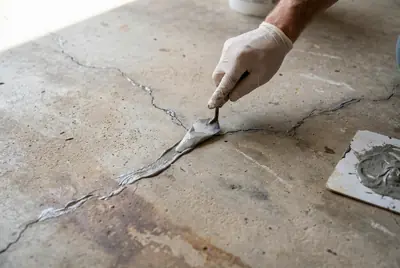
Hairline cracks get chased open, cleaned and filled with a rigid repair paste; spalled patches are rebuilt flush. Control joints are either honored or filled, and we lay out the trade-off of each choice for your garage before you pick.
Ground moisture rising through a basement slab will lift any coating from below. We test for it instead of guessing, and when a slab reads wet we quote a moisture-tolerant base layer or say honestly that epoxy is the wrong answer for that room.
Three ways to finish the same slab. None of them is wrong; they trade looks, grip and forgiveness differently, and the honest comparison fits in one table.
Most garages choose flake, most basements argue between flake and solid, and metallic is picked with the heart. All three get the same prep underneath.
Machines with vacuum shrouds open the slab pore by pore. The dust stays in the extractor, not on your shelves or the car in the driveway.
Chased, cleaned, filled rigid and sanded flush. Repairs disappear under flake; under metallic we flatten them until the light stops finding them.
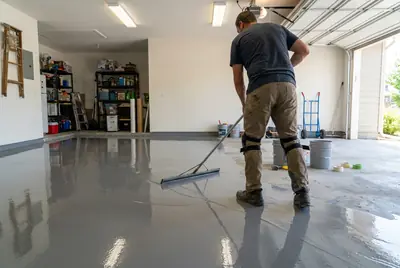
Pigmented epoxy goes down in ribbons and is pulled tight with squeegees, working from the far wall to the door so nobody paints themselves into a corner.
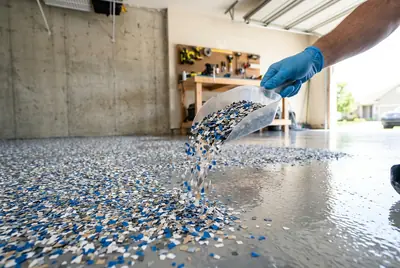
Thrown by hand into the wet base until the floor refuses to take another chip. The loose surplus is scraped and recovered the next morning.
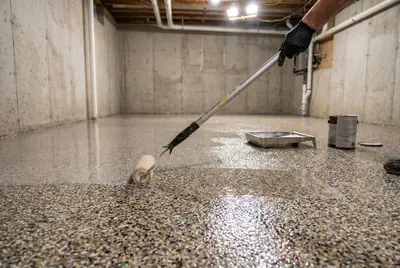
A chemical-resistant clear coat locks the color down and carries the actual wear. This is the layer your tires, ladders and dropped wrenches will meet.
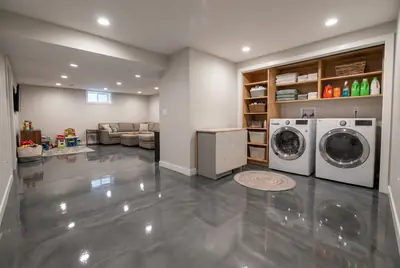
We walk the finished floor with you, leave a one-page care sheet, and tell you to the hour when feet, furniture and finally the car can come back.
Coats go down and the door stays shut. The resin needs still air and patience more than it needs anything from you.
On a typical cure, socks and light foot traffic are fine a day after the topcoat. Kitchen chairs can wait one more.
Most floors take tires again on the third day. We confirm the exact hour for your resin and your weather before we leave, and it goes on the care sheet.
Cold snaps stretch these numbers and warm dry days shorten them, which is why we give you dates in person rather than promises on a website.
ZIP, the floor in question, your name and number. A crew member, never a script reader, rings back inside a business day.
We come out, measure, read the moisture, poke the cracks and look at where the water goes. You get a square-foot price in writing before we leave the driveway.
Usually two or three, most of it prep. The cars sleep outside, the grinder hums for a day, and the pour itself is almost an anticlimax.
A walkthrough, a care sheet, and the exact hours for feet and tires. If anything bothers you in the first weeks, the same crew comes back to look.
Slab condition moves every line, mostly through prep hours. The walkthrough turns these brackets into one written figure for your floor.
The internet is full of peeling garage floors, so let us say the quiet part out loud. Nearly every failed epoxy job fails the same way: hot tire pickup, where a warm tire parks on a poorly bonded coating overnight and peels it off like a sticker on the way out. That is not an epoxy problem. It is a prep problem, which is exactly why the grinder gets a whole day and the roller kit from the hardware store does not stand a chance.
Sunlight is the other truth. Plain epoxy yellows slowly under UV, which matters at a bright garage door and in a walk-out basement. Where the sun reaches, we finish with a UV-stable topcoat and tell you plainly which parts of the floor will see the most light.
Treated fairly, a properly ground and coated floor keeps its gloss through years of tires, bikes, paint cans and dropped tools, and a tired one can usually be revived with a single recoat instead of starting over. We put the workmanship promise in writing with the estimate, in sentences, not asterisks.
You can, and for a year it may even look fine. The kits are thin, the prep instructions amount to washing the slab, and the bond shows it. What we grind, repair and build up in layers is a different product that happens to share a name.
Plan on two to three working days of coating around Smithfield plus the cure: feet at about a day, tires at about three. Most families park in the driveway for a week and never think about it again.
It will hide repaired cracks. Unrepaired ones telegraph straight through, which is why chasing and filling them is part of every quote instead of an upsell. If a crack is still moving, we flag it before any money gets spent over it.
A bare gloss coat can be, so we do not hand those over. Flake floors carry their own texture, and smooth finishes get an anti-slip grit stirred into the topcoat. You choose how much bite you want; sock-footed households usually go finer.
It is the first thing we measure. Mild readings call for a moisture-tolerant base layer under the epoxy; heavy ones mean epoxy is the wrong tool, and we tell you that at the walkthrough instead of after the peel.
Old paint comes off, not gets covered. The grinder strips it back to honest concrete, because a new coating is only ever as attached as whatever sits underneath it. Budget-wise it is a line of prep hours, not a mystery.
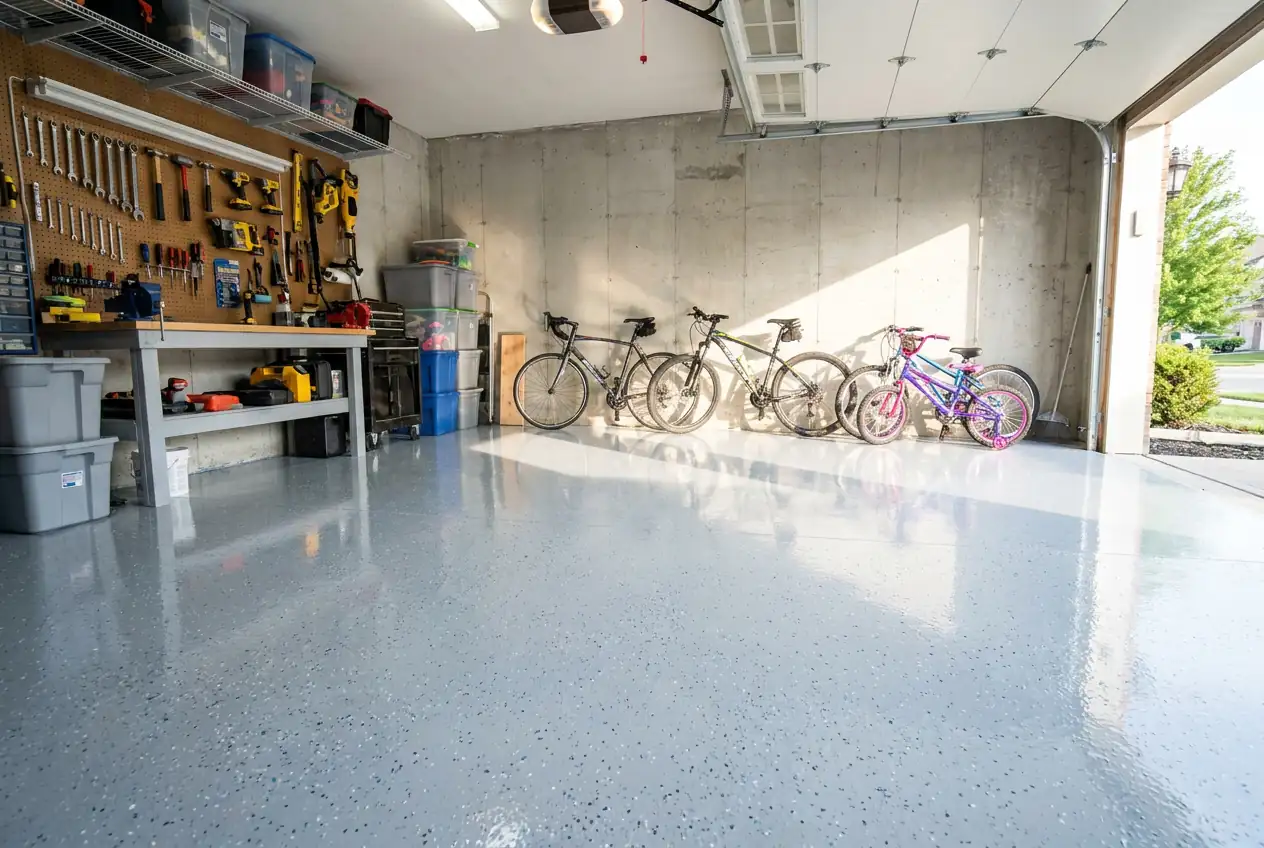
No staged pictures of empty rooms. This is what a lived-in garage looks like when the slab underneath finally got taken seriously: bikes, tool wall and all, on a sheet of color you can mop on Saturday morning.
Pan around to read the terrain; the place lists at the foot of this page name every community our trailer reaches from here.
One ground slab between your garage and the floor you keep showing people.
Get my written estimate